
Year-End Charitable Giving: Simple Strategies to Consider
There's a famous quote often credited to Winston Churchill: "it is more agreeable to have the power to give than to receive." The holiday season is a good time to think about charitable giving and how it fits into your financial plan. Smart charitable planning can help you support causes you care about while also reducing your taxes. The key question isn't just whether to give, but how to give in ways that help both the charities you support and your own financial situation.
This year is especially important for charitable planning. The recently passed One Big Beautiful Bill Act (OBBBA) includes changes that affect charitable giving. Also, donations for this tax year must be made by December 31, so now is a good time to review your giving strategy.
Household net worth has reached a new record level
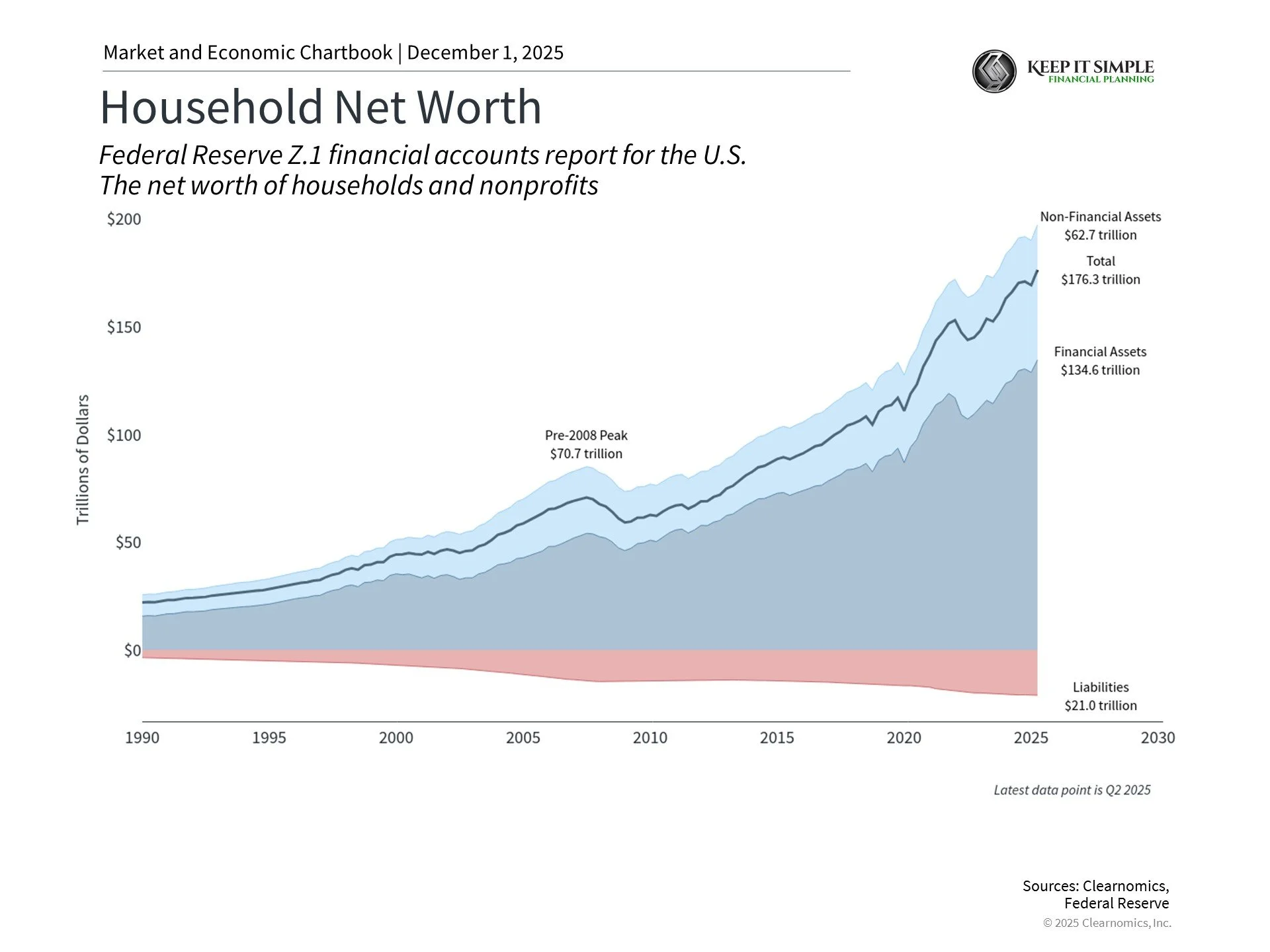
Americans gave $593 billion to charity in 2024, a 6.3% increase from 2023, according to the National Philanthropic Trust.1 This shows that charitable giving remains important for many households. As the chart shows, household net worth (the total value of what people own minus what they owe) has increased steadily. Greater income and wealth, along with changes in tax laws, have created new reasons to give.
Charitable giving also plays an important role in estate planning (planning for how your assets will be distributed after you pass away). Assets left to charity are not subject to estate tax, which is a tax on the transfer of wealth. This makes charitable gifts an efficient way to reduce taxes while supporting causes you care about. Most importantly, charitable giving can help create a lasting legacy and reinforce family values across generations.
Timing and structure matter more than ever
The OBBBA has created important changes for charitable giving. Most significantly, it increases the number of people who can itemize their tax returns (listing specific deductions instead of taking a standard amount) by raising the state and local tax deduction cap from $10,000 to $40,000. Since charitable contributions are only tax deductible if you itemize, this increases their importance in tax planning.
Additionally, starting in 2026, the OBBBA introduces a minimum threshold for charitable deductions. Only charitable gifts exceeding 0.5% of your adjusted gross income (your total income minus certain deductions) will be deductible. For someone with $200,000 in income, for example, only donations above $1,000 would be deductible.
One strategy to overcome this challenge is "bunching," which means combining multiple years of giving into a single tax year. Another key consideration is deciding which assets to donate. For example, donating stocks or other investments that have increased in value offers three tax benefits: it avoids capital gains tax (tax on the profit from selling an asset), removes the asset from your estate, and provides a deduction on your regular income. This can be especially helpful during years with significant gains.
Common ways to give to charity
Different charitable giving methods serve different purposes. Here are some common examples:
Donor-advised funds (DAFs) work like charitable savings accounts. You make a contribution, receive an immediate tax deduction, and then recommend grants to charities over time. The funds can be invested and grow tax-free while you decide when and where to give. DAFs are especially valuable in years when maximizing deductions is important and are simpler than other options.
Qualified charitable distributions (QCDs) are available for those aged 70½ or older with traditional IRAs (individual retirement accounts). QCDs allow you to transfer up to $108,000 for tax year 2025 directly from your IRA to charities. This can satisfy required minimum distribution rules (the amount you must withdraw from retirement accounts each year) while excluding the amount from taxable income. QCDs provide tax benefits regardless of whether you itemize.
Charitable remainder trusts (CRTs) provide another option. With a CRT, you transfer assets into a trust (a legal arrangement) that pays you or other beneficiaries income for a specified period, with the remainder going to charity. This can be especially useful for assets that have increased significantly in value.
These examples represent some of the most common charitable giving methods, but there are additional options that may be appropriate depending on your specific situation. Working with a trusted advisor can help determine which approach best fits your goals.
Charitable giving as part of your overall plan
The most effective charitable planning integrates giving into your broader financial strategy. This approach considers how charitable giving works together with investment management, tax planning, retirement income, and estate planning.
Perhaps most importantly, involving children and grandchildren in charitable decisions creates opportunities to discuss what matters most to your family and why certain causes deserve support. These conversations can be among the most meaningful aspects of wealth planning.
The bottom line? With year-end approaching and new tax rules creating opportunities, now is a good time to review the timing and structure of your charitable gifts. This can help maximize both your impact on causes you care about and your financial goals.
1. https://www.nptrust.org/philanthropic-resources/charitable-giving-statistics/
Want to learn how Keep It Simple Financial Planning can help? Please don’t hesitate to reach out here.